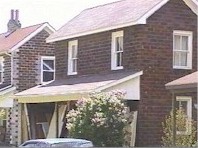
Haydenville, Ohio
excerpt from Dr. Ivan Tribe's report
Used with permission of the author Dr Ivan M. Tribe. Was first published in Buckeye Hill Country: A Journal of Regional History is published by the University of Rio Grande at Rio Grande, Ohio
"The other real pioneer in the Hocking Valley Coal industry, Peter Hayden, also entered business in 1852. Hayden's mines also bordered on the Hocking Canal in Green Township a few miles east of Nelsonville. The proprietor, a native of New England where he was born in 1806, began operation of a foundry in Columbus in the 1840's which he apparently operated with the partial aid of convict laborers leased from the Ohio state prison. Hayden also started the valley's first company town and store at the site of his mine. He apparently ran his community with a considerable degree of benevolent paternalism and enjoyed generally peaceful relations with his labor force. In 1877, he and his wife sponsored a Christmas celebration where Mrs. Hayden "entertained the families of the employees [in a] princely manner." The children received gifts at a Christmas tree while adults "banqueted on oysters, etc." From 1882 Hayden's firm also manufactured ceramic products and eventually discontinued coal mining. Despite his favorable reputation as an employer, Hayden probably best typifies the absentee owner, because he finally forsook Columbus for New York City where he died in 1888. Under a series of successors, most notable the National Fireproofing Company, Haydenville remained a corporate controlled community until 1964 when the factories and kilns shut down for the last time."
Excerpt From Emmett Conway Sr. - Ye Olde Forrester website:
“In 1856, a charcoal furnace located at Hanging Rock, Ohio, near Ironton, was purchased and removed by canal boats to this site which then was given the name of Hocking Furnace. The development of the charcoal iron industry attracted the attention of Peter Hayden, Columbus businness man, who was expanding his activities. He owned a line of canal boats which gave him transportation facilities (which were important in those days). He began to buy into the Dille, Brice and Moore Company until finally he was the sole owner. Halleck Hayden, a nephew, was made first manager of the furnace under his ownership. Charcoal fuel was manufactured in the hills and valleys surrounding the respective plants which were in operation for many years, but with new developments in the iron manufacturing industry, they made way for more progressive methods.”
Haydenville, Ohio, a few miles down the Hocking River from the county seat of Logan is on THE NATIONAL REGISTER OF HISTORIC PLACES because it is a unique company village whose owners developed and promoted vitrified ceramic building materials for a variety of architectural uses---not because of it being the site of the most northerly of the Hanging Rock Iron Region blast furnaces.
The small village, bypassed by U.S. Route 33, is one of the tourist attractions of Hocking County. Most unusual are the demonstration houses which are still occupied. There is a church devotedly and attractively fashioned from company tile as a product advertisement. One house is perfectly round. Sad to say, there are only remnants of the company headquarters building.
Haydenville Wolfe Cemetery Transcription
by Jody Cullison and Joyce Ann Abram
History of Haydenville website
from the Ohio University College of Communications
Peter Hayden was born in 1806 in Massachusetts and moved to Columbus, Ohio when he was a young man. Until 1845, not much is known about his life. Hayden sat on the Board of Directors of the Exchange Bank in Columbus. In the 1850s he began acquiring land south of Columbus and began to expand his iron foundry business. When he purchased a bit of land that ran alongside of the canal, Hayden decided to set up shop. The piece of land was built up around a single iron furnace and became known as Haydenville.
Until 1882, Haydenville prospered in the pig iron business. Because of increasing pressure from the competition in Pittsburgh and Northeast Ohio, Hayden decided to begin producing clay products instead. Peter Hayden began building a clay products plant, a church, a company store, and employee housing. Each building was built from the bricks produced in the plant. In 1888 Peter Hayden dies and the company is left to his heirs.